
Projection vs Sillage vs Longevity: What’s the Difference?
If you are new to perfumes, terms such as projection, sillage and longevity can make fragrance performance sound more complicated than it really is.
A perfume can project strongly but disappear relatively quickly. Another fragrance may sit close to your clothes for hours without filling a room. A third may leave a noticeable scent trail behind you even when the person wearing it has already walked past.
These are different aspects of perfume performance, and understanding them can help you choose a fragrance based on how you actually want it to behave.
Quick Answer:
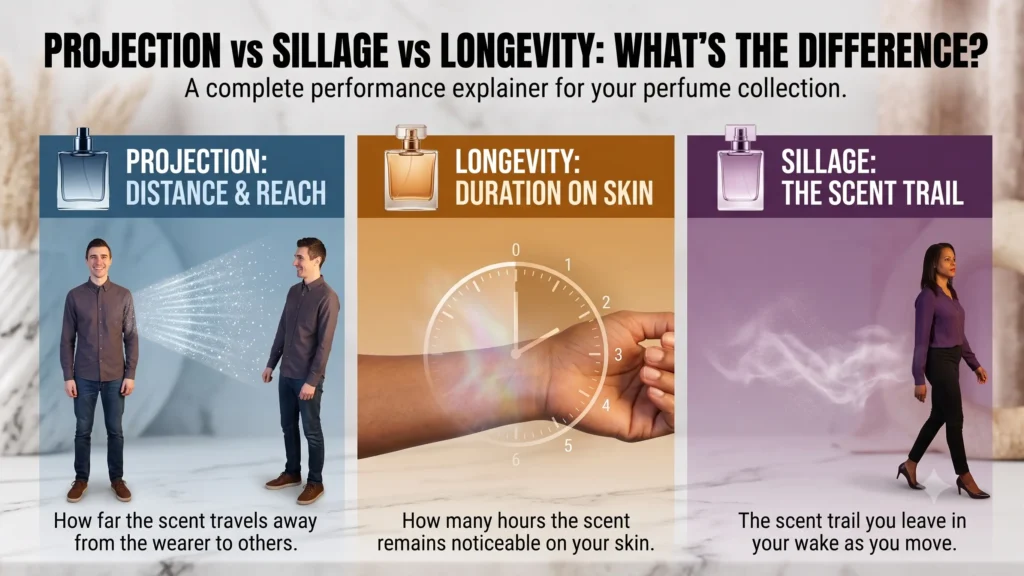
Projection is how far a perfume radiates from you, sillage is the scent trail it leaves as you move, and longevity is how long the fragrance remains detectable. A perfume can perform strongly in one area without being equally strong in the other two.
Projection vs Sillage vs Longevity: Quick Comparison
| Perfume term | What it means | Simple example |
|---|---|---|
| Projection | How far the fragrance radiates from you | Someone standing nearby can smell your perfume |
| Sillage | The scent trail left behind as you move | Someone notices your fragrance after you walk past |
| Longevity | How long the fragrance remains detectable | You can still smell it several hours after applying |
Think of it this way:
Projection = distance
Sillage = trail
Longevity = time
They are connected, but they are not the same thing.
1. What Is Projection in Perfume?
Perfume projection is the distance a fragrance radiates away from the wearer and can be detected by people nearby.
Imagine you enter an office wearing perfume. If a colleague standing a short distance away notices your fragrance without coming close to you, the perfume is projecting.
A fragrance with strong projection creates a larger scent presence around the wearer. A fragrance with softer projection stays closer to the skin or clothing.
How does perfume projection change?
Projection isn’t normally constant throughout the life of a fragrance.
Immediately after spraying, volatile materials in the opening can create a noticeable burst. As these evaporate and the fragrance develops, its projection may gradually become softer.
This means a perfume that feels powerful during the first half hour may become much more intimate later.
Is strong projection always better?
No.
The right amount of projection depends on where and how you are wearing the fragrance.
For example:
- Office: moderate or softer projection may be more comfortable.
- Dinner: controlled projection can create a noticeable presence without overwhelming others.
- Outdoor event: stronger projection may be desirable because the fragrance disperses more easily in open air.
- Party: a more noticeable fragrance can work well in a busy environment.
A good perfume doesn’t need to fill a room to perform well.
2. What Is Sillage in Perfume?
Sillage is the scent trail a perfume leaves in the air as the wearer moves.
The word comes from French and is commonly pronounced approximately “see-yazh”.
Imagine someone walks past you and, a few seconds later, you can still smell their perfume.
That lingering fragrance trail is sillage.
Sillage isn’t the same as projection
This is one of the most common points of confusion.
Suppose someone is standing next to you.
If you can smell their perfume radiating around them, that’s projection.
They then walk away.
If their fragrance remains noticeable in the air after they have moved, that’s sillage.
So:
Projection describes the scent around you. Sillage describes the trail you leave behind.
A fragrance can therefore have moderate projection but still produce an attractive scent trail when the wearer moves.
3. What Is Longevity in Perfume?
Perfume longevity is the amount of time a fragrance remains detectable after application.
It is essentially the fragrance’s lifespan on your skin or clothing.
A perfume develops after you apply it. The opening may feature brighter or more volatile materials, followed by the heart and eventually the base or dry-down.
But longevity isn’t simply about how long the opening lasts.
If you can still detect the fragrance several hours later, even if it has become much softer, it still has longevity.
Does long-lasting perfume mean strong perfume?
Not necessarily.
This distinction is important.
A fragrance could remain detectable on clothing for many hours while projecting only softly.
Another perfume could create a powerful opening for the first hour and then fade considerably.
So a perfume can have:
High projection + moderate longevity
or:
Low projection + high longevity
Neither is automatically better.
It depends on what you want from the fragrance.
Projection vs Sillage: What’s the Real Difference?
Here’s an easy example.
Imagine you spray perfume before entering a wedding reception.
Projection
You are standing and talking to friends.
People around you can smell your fragrance.
That’s projection.
Sillage
You walk across the room.
Someone notices the fragrance lingering behind you.
That’s sillage.
Longevity
Several hours later, you can still detect the fragrance on your shirt.
That’s longevity.
All three describe performance, but they measure different things.
What Affects Perfume Projection, Sillage and Longevity?
Perfume performance isn’t determined by concentration alone. The fragrance composition, amount applied, environment, skin, clothing and even your own sense of smell can influence what you experience.
1. Fragrance composition
Different fragrance materials behave differently.
Some materials are more volatile and can create a noticeable opening before evaporating relatively quickly. Other materials evaporate more slowly and may remain detectable for longer.
That’s why two perfumes with the same stated concentration can perform very differently.
2. Indian heat and humidity
Weather can significantly change the way you experience a fragrance.
Warm conditions can increase evaporation, making certain notes feel more noticeable initially. High humidity can also change how a fragrance feels and disperses.
In cities such as Mumbai and Chennai, a fragrance may behave differently from the same perfume worn in a cool, air-conditioned environment.
This is one reason perfume performance should be treated as a range rather than a guaranteed number of hours.
3. Skin and clothing
Perfume can behave differently on skin and fabric.
Skin temperature, moisture and natural oils can influence how a fragrance develops. Clothing may hold some fragrance materials for longer, although the effect depends on the perfume note and fabric.
If you apply fragrance to clothing, first consider whether the formula could mark delicate or light-coloured fabrics.
4. Number of sprays
More sprays can increase the amount of fragrance present, but more isn’t automatically better.
Overspraying can make a fragrance uncomfortable for people around you and can also make it harder for you to judge its performance.
For offices and enclosed environments, controlled application is usually more appropriate.
5. Where you apply perfume
Application can influence how the fragrance is experienced.
Areas around the hips and upper body can help you notice the fragrance as you move, while clothing can retain fragrance longer than skin.
There isn’t one perfect application method for every perfume.
Why You Stop Smelling Your Perfume
Have you ever applied a fragrance in the morning and thought it had disappeared, only for somebody else to notice it later?
The perfume may still be there.
Repeated exposure to the same smell can make you less sensitive to it. This is often described as olfactory adaptation or, more casually, nose blindness.
It means your own nose isn’t always the best instrument for judging longevity.
If you continuously smell your perfume because it is applied close to your nose, you may become accustomed to it.
This is also why immediately adding more sprays isn’t always the best response when you think a fragrance has disappeared.
Does Perfume Concentration Determine Performance?
Concentration matters, but it doesn’t tell the whole story.
Terms such as Eau de Toilette, Eau de Parfum and Parfum can indicate differences in fragrance concentration, but higher concentration doesn’t automatically mean greater projection or lasting.
The formula itself matters.
A concentrated fragrance may remain close to the wearer for a long time, while a lighter composition may create a brighter and more noticeable opening.
For this reason, don’t judge a perfume only by:
“How many per cent perfume oil does it contain?”
Also consider:
- fragrance composition,
- projection,
- sillage,
- longevity,
- climate,
- occasion,
- and how it performs on you.
How to Choose Perfume Based on Performance
Instead of simply searching for the “strongest perfume”, think about where you plan to wear it.
| Occasion | Projection | Sillage | Longevity |
|---|---|---|---|
| Office | Low–Moderate | Controlled | Moderate–Long |
| Daily wear | Moderate | Moderate | Moderate |
| Date or dinner | Moderate | Noticeable | Moderate–Long |
| Party | Moderate–Strong | Noticeable | Long |
| Outdoor event | Moderate–Strong | Moderate–Strong | Long |
These aren’t strict rules. They’re practical starting points.
For example, a powerful perfume may be enjoyable outdoors but uncomfortable in a small meeting room.
Performance should suit the occasion, not simply be as strong as possible.
How to Get Better Performance from Your Perfume
A few simple habits can help you get more from your fragrance without overspraying.
- Start with clean skin and clothing. Applying fragrance after bathing gives you a neutral base from which to judge its development.
- Use an appropriate number of sprays. Consider the strength of the fragrance and where you’ll be wearing it rather than automatically applying more.
- Test clothing application carefully. Fabric can sometimes hold fragrance for longer, but test first because some concentrated formulas may mark certain materials.
- Store perfume away from heat and direct sunlight. A cool, dry and relatively stable environment is preferable to a bathroom, hot vehicle or sunny windowsill.
- Reapply when necessary. For a long day, a small reapplication may be more comfortable than heavily spraying before leaving home.
Strong Projection vs Long Longevity: Which Is Better?
Neither.
The better choice depends on your purpose.
If you work in an office, you may prefer good longevity with controlled projection.
For a party or outdoor function, you might prefer a fragrance with more noticeable projection and sillage.
For everyday use, balance is often more useful than extreme performance.
A fragrance that smells pleasant, suits the environment and remains noticeable for a reasonable period can be more wearable than one that simply projects as strongly as possible.
Frequently Asked Questions
What is the difference between projection, sillage and longevity in perfume?
Projection is how far a perfume radiates from the wearer, sillage is the fragrance trail left behind as the wearer moves, and longevity is how long the fragrance remains detectable. A perfume can have strong projection but moderate longevity, or long longevity with relatively soft projection.
What does projection mean in perfume?
Projection describes how far a fragrance extends into the surrounding air from the person wearing it. Strong projection makes a perfume noticeable from farther away, while softer projection keeps the fragrance closer to the wearer.
What does sillage mean in perfume?
Sillage describes the fragrance trail that remains in the air as someone wearing perfume moves through a space. It is different from projection, which refers to how far the scent radiates around the wearer.
Can a perfume have good longevity but weak projection?
Yes. A perfume may remain detectable on skin or clothing for many hours while staying relatively close to the wearer. Longevity measures time, whereas projection measures distance, so strong performance in one doesn’t guarantee strong performance in the other.
Why can’t I smell my perfume after a few hours?
One possible reason is olfactory adaptation, where your nose becomes less sensitive to a fragrance after prolonged exposure. The fragrance may still be detectable to other people. Heat, application, composition and evaporation can also affect how long you notice it.
Does higher perfume concentration mean better projection?
Not necessarily. Concentration can influence performance, but the fragrance formula and materials used also matter. A highly concentrated fragrance can have excellent longevity while projecting softly, whereas another composition may produce a stronger initial projection.
Does perfume last longer on clothes or skin?
Fragrance can sometimes remain detectable on fabric longer than on skin because clothing isn’t affected by skin temperature and oils in the same way. However, results vary by fragrance and fabric, and concentrated perfumes should be tested before applying them to delicate materials.
Final Takeaway: Projection vs Sillage vs Longevity, or call it Distance, Trail and Time
If perfume terminology still feels confusing, remember just three words:
Projection = Distance
How far can people smell the perfume around you?
Sillage = Trail
What fragrance do you leave in the air when you move?
Longevity = Time
How long can the perfume still be detected?
Understanding these differences makes it easier to choose fragrances for your office, daily wear, dates, parties or outdoor occasions rather than judging every perfume by how “strong” it is.
At Perfume & More, we prefer to look at fragrance performance as a combination of scent profile, projection, sillage, longevity, application and Indian weather. Individual results can vary, so testing a fragrance in the conditions where you actually plan to wear it is often the most useful way to judge performance.