
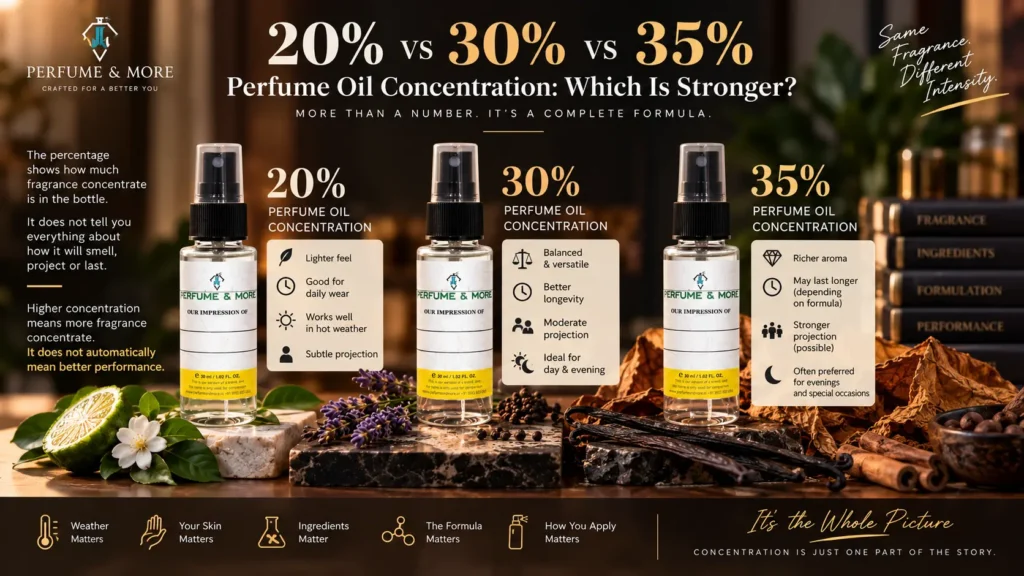
20% vs 30% vs 35% Perfume Oil Concentration: Which Is Stronger?
Short answer: 35% perfume contains more fragrance concentrate than 20%, but that does not automatically mean it will smell stronger, project further, last longer or be better quality.
Perfume performance depends on the complete formula, the fragrance materials used, the balance between notes, the alcohol-to-concentrate ratio, your skin, the weather and how the perfume is applied.
If you are comparing 20% vs 30% vs 35% Perfume Oil Concentration, the first thing to understand is that the percentage tells you about the amount of fragrance concentrate in the finished perfume. It does not tell you everything about how that perfume will perform.
This is especially important for Indian perfume buyers because heat, humidity, sweating, air conditioning and skin type can all change the way a fragrance smells and performs.
The simple rule: Higher concentration means more fragrance concentrate. It does not automatically mean better perfume performance.
- What perfume concentration means
- 20% vs 30% vs 35% comparison
- Is 35% stronger than 20%?
- Does higher concentration last longer?
- Can 20% project more than 35%?
- How Indian weather affects perfume
- EDP vs Extrait
- Does higher concentration mean better quality?
- What Indian customers should compare
- Frequently Asked Questions
What Does Perfume Oil Concentration Mean?
In simple terms, perfume concentration refers to the proportion of fragrance concentrate used in the finished perfume.
So, if two perfumes are made on the same basis, a 35% fragrance concentration contains more fragrance concentrate than a 20% fragrance concentration.
That part is simple.
The confusion starts when people assume that the percentage also tells them how long the perfume will last, how far it will project or how good the perfume will be.
| Question | Does concentration answer it? |
|---|---|
| Does 35% contain more fragrance concentrate than 20%? | Yes |
| Will 35% always last longer? | No |
| Will 35% always project further? | No |
| Does 35% automatically smell stronger? | No |
| Does 35% mean better ingredients? | No |
| Does 35% mean better quality? | No |
| Does 35% automatically mean better value? | No |
20% vs 30% vs 35% Perfume Oil Concentration: What Is the Difference?
Here is the easiest way to understand the three levels.
| Factor | 20% | 30% | 35% |
|---|---|---|---|
| Fragrance concentrate | Lower proportion | Higher proportion | Higher still |
| Alcohol proportion | Generally higher | Generally lower | Generally lower |
| Possible character | Can feel balanced and diffusive | Can feel richer | Can feel denser and richer |
| Projection | Depends on the formula | Depends on the formula | Depends on the formula |
| Longevity | Depends on the formula | Depends on the formula | Depends on the formula |
| Quality | Cannot be judged from percentage | Cannot be judged from percentage | Cannot be judged from percentage |
The most important words in this table are “depends on the formula”.
A perfume is not simply a percentage. The actual fragrance composition matters.
Is 35% Perfume Stronger Than 20%?
Not necessarily.
When someone says a perfume is “strong”, they may mean several different things:
- It smells powerful immediately after spraying.
- It projects far from the skin.
- It leaves a noticeable scent trail.
- It remains detectable for many hours.
- It smells rich or concentrated.
- It feels intense to the wearer.
These are not the same thing.
A perfume can have good longevity but sit relatively close to the skin. Another perfume can create a noticeable scent cloud for the first few hours but fade sooner.
So, 35% does not automatically mean stronger.
Does Higher Perfume Concentration Last Longer?
No, not automatically.
Longevity is strongly influenced by the fragrance materials used in the formula.
Some fragrance materials are highly volatile and evaporate quickly. Others are less volatile and remain detectable for much longer.
This is why citrus-heavy fragrances can behave very differently from perfumes built around woods, musks, amber materials, resins and other longer-lasting materials.
Think of it this way: adding more fragrance concentrate does not magically make every material inside that concentrate evaporate more slowly.
A well-formulated 20% perfume can therefore sometimes last longer than a poorly balanced 30% or 35% perfume.
Can a 20% Perfume Project More Than a 35% Perfume?
Yes, it can.
Projection depends on diffusion, volatility, the fragrance formula, the carrier and how the perfume is applied.
Alcohol is volatile and can help a fragrance disperse after spraying. Changing the relationship between fragrance concentrate and alcohol can therefore change how a perfume opens and diffuses.
This is one reason a lower-concentration perfume can sometimes feel more diffusive, while a higher-concentration perfume can feel richer, smoother or denser.
Neither behaviour automatically means that one perfume is better.
Projection vs Longevity: What Is the Difference?
| Term | What it means |
|---|---|
| Projection | How far the fragrance can be noticed from your body. |
| Sillage | The scent trail a fragrance leaves as you move. |
| Longevity | How long the fragrance remains detectable. |
| Concentration | The proportion of fragrance concentrate in the finished perfume. |
These terms are related, but they should not be used as if they mean the same thing.
What Does Perfume Concentration Mean in Indian Weather?
Indian weather makes this subject particularly interesting.
Heat, humidity, sweating, air conditioning and skin type can all affect how a perfume is experienced.
For example, a perfume worn outdoors in humid Mumbai weather can behave differently from the same fragrance worn inside an air-conditioned office.
That is why choosing a perfume only because it says 30% or 35% is not necessarily the best approach.
Summer
During very hot weather, a dense fragrance can sometimes feel heavy when over-applied.
Fresh, citrus, aquatic, aromatic and lighter woody fragrances may feel more comfortable for daytime use, depending on the formula.
Monsoon
Humidity can change how fragrance feels on the skin. Some perfumes may become more noticeable, while others may feel heavier or sweeter.
Controlled application becomes important. More perfume is not always the answer.
Winter and Cooler Evenings
Richer fragrances can feel particularly comfortable during cooler evenings because the environment is less hot.
Air-Conditioned Offices
An office is different from outdoor heat. A perfume that feels powerful outside may behave differently inside an air-conditioned room.
For professional settings, controlled projection is usually more practical than trying to fill the entire room with fragrance.
20% vs 30% vs 35%: Which Is Better for India?
| Situation | What to consider |
|---|---|
| Hot summer daytime | Freshness, comfort and controlled application may matter more than chasing the highest concentration. |
| Humid Mumbai weather | Consider how the complete fragrance behaves on your skin rather than the percentage alone. |
| Office | Controlled projection and comfort are usually more useful than maximum intensity. |
| Date night | Consider scent character, drydown and how noticeable you want the fragrance to be. |
| Wedding or evening event | A richer fragrance can work well, but application still matters. |
| Everyday wear | Balance, comfort and value can be more important than the biggest percentage. |
EDP vs Extrait: What Is the Difference?
You will often see concentration discussed alongside terms such as Eau de Parfum and Extrait de Parfum.
These terms can indicate a style of formulation, but they should not be treated as guaranteed performance rankings.
| Feature | Eau de Parfum | Extrait de Parfum |
|---|---|---|
| Typical impression | Balanced and versatile | Often richer and denser |
| Concentration | Generally lower than Extrait | Generally higher than EDP |
| Projection | Can be excellent | Can be strong, soft or close depending on formula |
| Longevity | Can be excellent | Can be excellent |
| Skin feel | Often lighter | Often richer |
Extrait does not automatically mean better, and EDP does not automatically mean weak.
Does Higher Perfume Concentration Mean Better Quality?
No.
Concentration tells you how much fragrance concentrate is used. It does not tell you:
- the quality of the fragrance materials;
- the cost of those materials;
- how accurately the fragrance has been constructed;
- how well the perfume develops;
- how it performs on your skin;
- how balanced the formula is;
- how stable the finished product is; or
- whether you will personally enjoy the scent.
Do not use concentration as a quality score.
It is one piece of information about a perfume formula, not a complete review of the finished fragrance.
Does More Perfume Oil Mean Better Value?
Not necessarily.
A higher percentage tells you something about the formulation, but it does not automatically tell you which bottle gives better value.
When comparing perfumes, consider:
- the price;
- the bottle size;
- how much you need to spray;
- how long the fragrance remains enjoyable;
- whether you actually like the scent;
- how versatile it is; and
- how it performs in your local climate.
A perfume you genuinely enjoy wearing can provide better personal value than a more concentrated fragrance that remains unused.
Does 35% Perfume Mean It Is More Similar to the Original?
No.
If you are buying an inspired or clone-style fragrance, concentration does not tell you how accurately the scent has been constructed.
A higher concentration does not automatically make a fragrance smell more like the perfume that inspired it.
Similarity depends on the actual fragrance composition and how the formula has been constructed.
What About 25% Perfume Concentration?
Indian customers will also see perfumes around 25% concentration.
25% can be a useful formulation level, but the percentage alone cannot determine whether a perfume is good.
At Perfume & More, perfume sprays can be formulated with up to around 25% concentrated base oil, depending on the product and formulation.
We treat concentration as one part of the formulation rather than the only measure of quality or performance.
How Perfume & More Looks at Perfume Concentration
Perfume & More has been working with inspired fragrances and fine fragrance oils in Mumbai since 2017.
The approach is to look at the complete finished fragrance, rather than treating a percentage printed on a product description as a performance score.
Our approach considers practical Indian conditions, including heat, humidity, air-conditioned offices, travel and everyday use.
You can learn more about our fragrance business and background on our About Us page.
We also offer a range of inspired fragrances through our Perfume & More shop.
Why Indian Perfume Buyers Should Look Beyond the Percentage
India is a large and climatically diverse market.
A perfume worn outdoors in Mumbai during a humid afternoon can behave differently from the same perfume worn inside an air-conditioned office in Bengaluru or during a cooler evening in Delhi.
Your skin, application, clothing, temperature, humidity and environment all contribute to the final experience.
That is why real-world testing matters.
When comparing 20% vs 30% vs 35% Perfume Oil Concentration, look at the complete fragrance rather than choosing only the largest number.
Explore Inspired Perfumes from Perfume & More
If you are looking for inspired fragrances for everyday wear, office use, dates or special occasions, explore our range based on the scent profile you actually enjoy.
What Should Indian Customers Compare When Buying Perfume?
- Smell the fragrance first. Concentration cannot tell you whether you will enjoy the scent.
- Check the opening. Notice how the perfume smells immediately after spraying.
- Check the drydown. A fragrance can change considerably after the opening.
- Check projection. See how noticeable it is around you.
- Check longevity. See how long you can still detect it on your skin or clothing.
- Consider your climate. Indian heat and humidity can change the wearing experience.
- Consider the occasion. Office, college, travel, dates and weddings can call for different fragrance styles.
- Check formulation information. Look beyond the percentage printed on the bottle.
- Compare the complete price and size. Do not compare concentration alone.
- Choose what you will actually enjoy wearing.
20% vs 30% vs 35%: What Should You Actually Buy?
| If You Care Most About… | What You Should Look At |
|---|---|
| Long-lasting perfume | Formula, materials, drydown and your skin — not concentration alone. |
| Strong projection | Diffusion and formula rather than simply the percentage. |
| Rich fragrance | Concentration, materials and overall composition. |
| Office perfume | Controlled projection and comfort. |
| Summer perfume | Freshness, balance and performance in heat. |
| Date-night perfume | Character, drydown and how noticeable you want it to be. |
| Best value | The complete product experience and price, not oil percentage alone. |
A Simple Example: 20% vs 35%
| Example | Perfume A | Perfume B |
|---|---|---|
| Concentration | 20% | 35% |
| Fragrance concentrate | Lower proportion | Higher proportion |
| Projection | Could be high | Could be high, moderate or close |
| Longevity | Could be excellent | Could be excellent |
| Quality | Cannot be judged from concentration | Cannot be judged from concentration |
| Which is better? | The complete fragrances need to be compared. | |
Does Perfume Concentration Affect Safety?
Concentration and safety should not be confused.
A higher concentration does not automatically mean a perfume is unsafe. Similarly, a lower concentration does not automatically prove that a product is safe for every individual.
Fragrance formulas can contain many different materials, and some fragrance ingredients have restrictions or usage limits depending on the finished product.
For fragrance safety information, the International Fragrance Association (IFRA) publishes standards relating to the safe use of fragrance ingredients.
For India-specific cosmetic regulation and information, you can also refer to the Central Drugs Standard Control Organisation (CDSCO).
Important: This article is general educational information about perfume formulation. It is not a medical or regulatory assessment of any particular perfume. Always follow the product label and manufacturer instructions.
Can Perfume Cause Skin Irritation?
Yes. Any fragranced cosmetic can cause irritation or an allergic reaction in a person who is sensitive to one or more ingredients.
This is not limited to inexpensive perfumes or high-concentration perfumes.
If a perfume causes persistent burning, itching, redness, swelling or another concerning reaction, stop using it and seek appropriate medical advice.
The Biggest Perfume Concentration Myth
Myth: “35% perfume must last longer than 20% perfume.”
Reality: A higher concentration means a greater proportion of fragrance concentrate, but longevity depends on the complete fragrance formula and how its materials behave.
The same principle applies to projection, quality and similarity.
Do not let a single number make the entire buying decision for you.
Quick Takeaway
| Statement | Answer |
|---|---|
| Does 35% contain more fragrance concentrate than 20%? | Yes |
| Does 35% automatically last longer? | No |
| Does 35% automatically project further? | No |
| Does 35% automatically mean better quality? | No |
| Does 35% automatically smell better? | No |
| Does 35% automatically mean better value? | No |
| Does formulation matter? | Yes |
| Do fragrance materials matter? | Yes |
| Does Indian weather matter? | Yes |
Frequently Asked Questions About Perfume Concentration
Is 35% perfume stronger than 20%?
Not necessarily. A 35% perfume contains a higher proportion of fragrance concentrate, but that does not automatically mean it will smell stronger, project further or last longer. The complete fragrance formula and the materials used are important.
Does more perfume oil mean longer lasting perfume?
Not automatically. Longevity depends on the fragrance materials, their volatility, the balance of the formula, your skin and the environment. A well-formulated 20% perfume can sometimes last longer than a poorly balanced higher-concentration fragrance.
Is 30% perfume better than 20%?
There is no universal rule that 30% is better than 20%. A 30% perfume contains more fragrance concentrate, but quality, performance and comfort depend on the complete formulation.
Can a 20% perfume last longer than a 35% perfume?
Yes. Concentration is only one part of a perfume formula. The actual fragrance materials and how they behave can have a major effect on longevity.
Can a 20% perfume project more than a 35% perfume?
Yes. Projection depends on diffusion, volatility, the fragrance formula, the carrier and application. A higher concentration does not guarantee greater projection.
Does Extrait de Parfum always last longer than Eau de Parfum?
No. Extrait is generally associated with a higher fragrance concentration, but concentration alone does not determine longevity. The fragrance composition and individual materials also matter.
Is 35% perfume concentration safe?
A higher concentration is not automatically unsafe, but the finished formulation must be appropriately assessed and comply with applicable cosmetic and fragrance safety requirements. Concentration should never be treated as a safety guarantee.
Does a higher perfume concentration mean better quality?
No. Concentration tells you the proportion of fragrance concentrate used. It does not tell you the quality of the materials, accuracy of the fragrance construction, stability or overall quality of the finished product.
What perfume concentration is best for Indian weather?
There is no single concentration that is best for all of India. Heat, humidity, skin type, fragrance composition and the occasion all affect how a perfume performs. The complete formula matters more than simply choosing the highest percentage.
Is 25% perfume concentration good?
25% can be a useful formulation level, but the percentage alone cannot determine whether a perfume is good. The fragrance materials, balance, diffusion, drydown and real-world performance are also important.
Should I buy a perfume because it says 35% oil?
Do not make the decision based on concentration alone. Compare the fragrance itself, scent profile, drydown, projection, longevity, comfort, price and how it performs in your environment.
Final Thoughts: Is Higher Perfume Concentration Better?
There is nothing wrong with a perfume brand telling you that its fragrance contains 30% or 35% fragrance concentrate.
Transparency is useful.
The mistake is treating that percentage as a complete performance score.
35% tells you that there is more fragrance concentrate than 20%.
It does not automatically tell you that the perfume:
- lasts longer;
- projects further;
- smells better;
- uses better ingredients;
- is more accurate;
- is safer; or
- offers better value.
Good perfumery is about balance.
The fragrance materials, formulation, diffusion, drydown, skin, weather and application all contribute to the final experience.
So, when choosing between 20%, 30% and 35% perfume oil, do not simply ask:
“Which one has the biggest number?”
Ask instead:
“Which fragrance gives me the combination of scent, performance, comfort, quality and value that I actually want?”
Understanding 20% vs 30% vs 35% Perfume Oil Concentration helps you look beyond the percentage and make a more informed perfume-buying decision.